Artificial Friend (AF)
Klara and the SunAn Artificial Friend (AF) is a manufactured companion intended to live with and support a child. The role joins intimate care to commercial selection: AFs are displayed and purchased by families, distinguished by series and abilities, and judged both for how well they serve an individual child and for what their presence means in a changing society. Through Klara’s service to Josie, the novel presents an AF as a companion capable of responding to loneliness while remaining vulnerable to suspicion, replacement, and eventual obsolescence.
Models, Selection, and the Market
AFs are sold in successive models, and the distinctions matter to families making a choice. Manager describes Rex as a third-series B2 and recommends him as a companion who could encourage a conscientious, studious attitude. The Mother recognizes the model’s reported solar-absorption problems, making the product’s technical limitations part of the selection process rather than an abstract concern. Klara, in turn, judges herself unsuitable for a particular child, apologizes for the embarrassment caused, and accepts Manager’s conclusion that the girl will be happy with a B3 boy.
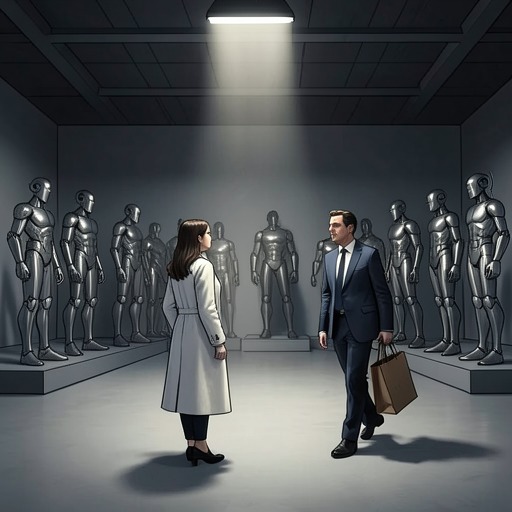
The store’s display makes this market cycle visible. Three new B3 boys are calibrated and placed in prominent positions: two in the window beside a new sign, and one in the front alcove. Another B3 has already been bought and shipped without the other AFs meeting him. Klara and Rosa are moved to the Red Shelves side, a change in position that follows the arrival of the newer models. Rosa’s eventual purchase from mid-store confirms Manager’s assurance that any position in the store can lead to selection; the ordinary day ends with Rosa behind the Staff Only Door, preparing for shipment.
That commercial life has a visible afterlife, too. When Klara later passes the site of the store, the window no longer contains AFs or the Striped Sofa: colored bottles and a Recessed Lighting sign have taken their place. The transformation turns a place of display and anticipated companionship into an ordinary retail frontage, registering how quickly the AF market can disappear from view.
Companionship and Care
An AF’s purpose is not limited to occupying a place in a household. Josie’s mother agrees that Rick may attend the interaction meeting, despite Josie’s insistence that the other children are not her friends; she acknowledges that Rick is a good person and their neighbor. In another account of the children’s rough social behavior, Klara understands that their unkindness may arise from fear of loneliness, and believes that Josie remains kind beneath her unusual behavior. This interpretation links the AF’s companionship to attention not only to a child’s needs but also to the social pressures surrounding her.
Klara later describes her time with Josie as continuous company, lasting until Josie leaves for college. Looking back, she believes she gave good service and prevented Josie from becoming lonely. The exchange gives the AF’s work a measure different from technical performance or popularity: its success lies in the sustained presence that made loneliness less familiar to the child in its care.
Limits, Vulnerability, and Social Response
AFs have model-specific physical limitations. Klara explains that B3s have limited smell, and that she herself has none; the conversation connects this restriction to safety, since smell might warn of burning. Together with concern about the third-series B2s’ solar absorption, this detail shows that the category does not imply uniform capacities. The companion’s usefulness is shaped by engineered features and omissions.
The novel also places AFs within a charged public debate. Henry Capaldi describes growing concern and resentment: people accept that AFs’ decisions and recommendations are usually dependable, yet fear that they cannot understand how the machines reach them. He proposes reverse-engineering them, treating the AF as a black box to be opened both to reduce public fear and to learn from what is inside. His appeal to Klara for help makes her simultaneously a valued source of knowledge and an object of invasive scrutiny. In contrast, the Father recognizes Rick’s drone work as impressive regardless of whether Rick was lifted, insisting that genuine ability deserves notice; the episode places the AF debate alongside broader judgments about technology, ability, and social inclusion.
Narrative Significance
The AF’s identity remains divided between commodity and relationship. The store’s models, placements, and shipments establish a system of purchase and replacement, while Klara’s account of service measures the same existence through attention, kindness, and the prevention of loneliness. The gap between these measures grows sharper when the store itself becomes a lighting shop and when people who admire AFs also propose opening them up for study.
Klara’s calm observation of the Yard’s ordered rows of discarded machinery supplies a final material counterpoint to the polished displays where AFs were once presented for selection. Objects that seem individually damaged are arranged with care into passages that can be inspected one by one. The image does not establish the fate of every AF, but it places artificial companionship within a world that sorts, replaces, and eventually stores the remains of useful things. Against that background, Klara’s belief that she helped Josie becomes a modest but consequential account of what an AF could mean beyond its model or market price.